



Introduction
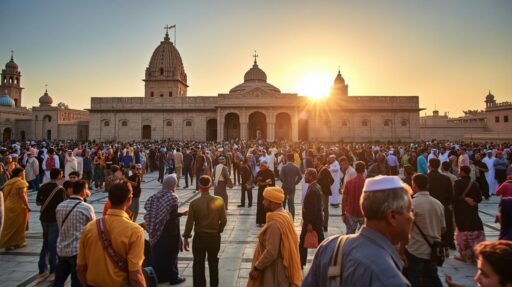
Five times a day, a hauntingly beautiful melody rises above the bustling cities and quiet deserts of the UAE. It is the Adhan, the Islamic call to prayer, a sound that has marked the passage of time for centuries. More than a simple announcement, the Adhan is a profound theological statement, a public declaration of faith, and a powerful thread that weaves the Muslim community together in a shared rhythm of devotion. To understand the Adhan is to listen to the very heartbeat of Islam in the Emirates.
The Words of the Call: A Translation of the Divine Invitation
The Adhan is a standardized recitation in Arabic, with slight variations between different Islamic schools of thought. Its words form a complete and powerful message:
- Allahu Akbar (repeated four times): “God is the Greatest.” This establishes the fundamental principle of Islam, the supremacy of God over all things.
- Ash-hadu an la ilaha illa Allah (twice): “I bear witness that there is no god but God.” This is the core declaration of monotheism (Tawhid).
- Ash-hadu anna Muhammadan rasul Allah (twice): “I bear witness that Muhammad is the Messenger of God.” This affirms the prophethood of Muhammad.
- Hayya ‘ala-s-Salah (twice): “Hasten to prayer.” This is a direct invitation to the community.
- Hayya ‘ala-l-Falah (twice): “Hasten to success.” This defines success in spiritual terms, as salvation through prayer.
- Allahu Akbar (twice): “God is the Greatest.” A final reaffirmation.
- La ilaha illa Allah (once): “There is no god but God.” The call concludes as it began, with the oneness of God.
The Muezzin: The Human Voice of the Divine Summons
The person who delivers the Adhan is the muezzin (or mu’adhin). Historically, the muezzin would climb the minaret to project his voice as far as possible. Today, microphones and loudspeakers carry the call, but the role of the muezzin remains one of great respect. He is chosen for his piety and, most importantly, for his beautiful and melodious voice. The delivery of the Adhan is considered an art form (Sawt), and a skilled muezzin can move listeners to deep spiritual emotion with his heartfelt recitation. His voice becomes a familiar and comforting presence in the daily life of the community.
A Regulator of Time and Community
In a pre-modern world without clocks, the Adhan was the primary means of regulating the day. The five prayers—Fajr (dawn), Dhuhr (noon), Asr (afternoon), Maghrib (sunset), and Isha (night)—are timed according to the sun’s position. The Adhan provided a celestial clock, synchronizing the activities of the entire community. Even in today’s digital age, the Adhan continues to mark the natural rhythm of the day. It is a moment of pause; conversations may halt, and the sound serves as a reminder for Muslims to disengage from worldly affairs, even if just mentally, and remember their spiritual obligations.
The Adhan in the Modern UAE: Tradition and Technology
In the contemporary UAE, the Adhan is a unifying soundscape. It is broadcast from thousands of mosques, its timing coordinated with precision. Smartphone apps and television channels also alert the faithful to prayer times. For the Muslim majority, it is a welcome and anticipated interruption. For non-Muslim residents and visitors, it is an integral part of the cultural experience, a symbol of the country’s Islamic identity and its tolerance in allowing this proclamation of faith to be heard publicly. The sound of the Adhan, whether heard from a luxury hotel or a humble neighborhood, is a constant reminder of the spiritual dimension that underpins the nation’s modern facade.
Conclusion: An Enduring Echo of Faith
The Adhan is far more than a ritual; it is a living, vocal testimony to faith that has echoed through 1,400 years of history. It is a call that transcends social class, ethnicity, and nationality, uniting all Muslims in a common act of worship. In the UAE, a nation that embraces the future while honoring its past, the Adhan remains a vital and cherished tradition. It is a daily renewal of the covenant of faith, a beautiful and powerful sound that ensures the spiritual heartbeat of the nation remains strong, inviting all who hear it to pause, reflect, and remember the divine.